Kitchen Dangerous (part 1)
#GeekingOutSeries/Safety101/KitchenDangerous/1
This post is part of the Geeking Out series which presents data-driven information on food and farming, safety in the kitchen, practical science for cooks, cooking techniques and processes and other relevant nerdy stuff that every cook should know.\xa0 For the next few weeks, we will be covering topics from the chapter, Safety 101.
In January of 1999, I arrived in Boston to begin my new life as an adult student at the \xa0Berklee College of Music. New to the area, I arranged to stay with a friend\u2019s friend who lived in the posh Back Bay area until I could find accommodations of my own.\xa0 My new roommate was an avid cook. \xa0I, on the other hand, had very little cooking skills.\xa0 So she generously cooked and shared her dinners with me.
One evening, my roommate went out to dinner and left me to fend for myself. \xa0I looked forward to my first Boston cooking experience.\xa0 Back in Manila, I lived in households which employed a cook, so I wasn\u2019t used to cooking, but had occasionally tried my hand at braising and pan frying. This wasn\u2019t going to be a big deal except that I had always cooked with gas cook tops where the size of the flames clearly indicated how hot the burner was.\xa0 This American kitchen had an electric range.
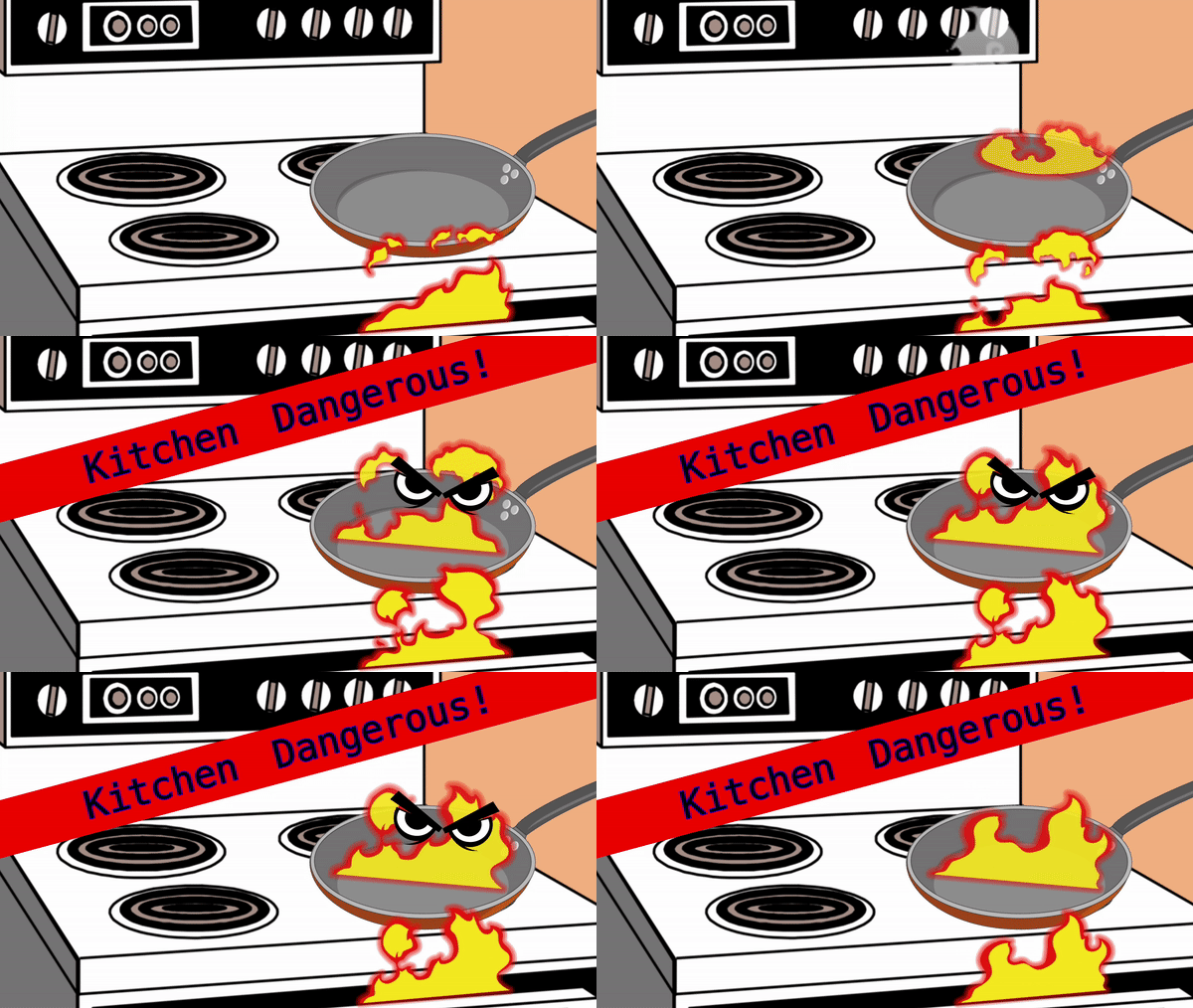
I don\u2019t recall exactly what was on the menu other than it was going to be pan-fried, but I remember setting the range indicator to Hi, placing a skillet on the stove top and pouring olive oil into it.\xa0 Within minutes, the olive oil in my pan was on fire.\xa0 Flames licked out of my skillet, several inches high. \xa0Panic shot through my veins but not quick enough to stifle the little voice that told me to put the flaming skillet into the kitchen sink and grab its lid to cover and snuff it out.
Smoke set off the fire alarm, rudely piercing an otherwise quiet Saturday evening. \xa0I\u2019d never handled a fire alarm before and didn\u2019t know how to turn it off. \xa0Was my alarm triggering alarms in the rest of the building?\xa0 It was so loud, I couldn\u2019t be sure. \xa0I imagined the fire crew would arrive any minute and I\u2019d have to explain the whole sorry episode while evacuated neighbors looked on. \xa0Maybe I\u2019d get kicked out of the country for wasting tax payers\u2019 money. \xa0Having averted a disaster, my chief concern now was preserving dignity.\xa0 I ran out of the apartment into the hall and banged on the nearest door.
\u201cCould you help me please? My smoke alarm went off and I don\u2019t know how to stop it.\u201d
The neighbor came over, opened the windows to let the smoke out then disconnected the alarm.\xa0 Opening the windows hadn\u2019t even occurred to me in my mental haze. \xa0So if my neighbor thought I was a silly foreigner, I didn\u2019t mind. I was just grateful and relieved. \xa0It was my first week in Boston.
And this is how I learned that olive oil can catch fire.\xa0\xa0\xa0
Another important detail in this story is that I smothered the fire with a lid.\xa0 Had I poured water, which may be instinctive to some, the story might have ended differently, if not tragically.\xa0 I knew somehow that water on a greased-based fire would make matters worse and that I needed to cut off the oxygen which fanned the flames. In a panicked state of mind, I was grateful I could recall this bit of knowledge.
And then there was the matter of my unfamiliarity with electric stoves.\xa0 With gas burners, you can easily see how hot your fire is. \xa0With an electric stove I\u2019d never used before, I didn\u2019t know how hot Hi could get. \xa0Now I do.
So what were my takeaways from this experience?
1. Know which cooking oils are for high and low heat and use accordingly.2. Kill a grease-based fire by smothering it.\xa0 3. If unfamiliar with an appliance, use cautiously. 4. Know your neighbor. \xa0\xa0\xa0\xa0\xa0\xa0\xa0\xa0\xa0
You can bet I\u2019ve learned these lessons well.
Today, the kitchen is a refuge for me, a place where I can be creative and have fun.\xa0 But to the uninitiated or uninformed, just as I was back then, the kitchen can be a dangerous place. By sheer luck and some knowledge I\u2019ve managed to avoid full blown disasters, and needless to say, these lessons are now indelibly etched in my mind.\xa0\xa0 Making mistakes is a natural and inevitable part of the learning process, especially if you\u2019re just negotiating your way around a kitchen.\xa0 But I hope I can help you avoid some of the bigger ones.
Liar, Liar Pans on Fire:\xa0 Fire and all things Hot\xa0
Many things in the kitchen can catch fire: Cooking oils; toast too near the heating element in a toaster oven; faulty appliances and overburdened or problematic electric outlets; ovens from grease build up; paper towels or other flammable objects near open flame; unattended pots with insufficient amounts of liquids.\xa0 Before we cover all that, here is our first rule.
Rule Number 1: Keep on hand an extinguisher rated for grease and electrical fires AND a box of baking soda No matter how careful you are, accidents happen and it\u2019s best to be prepared. \xa0Kitchen fires are not uncommon. \xa0You have only to read customer reviews for kitchen fire extinguishers (I had recently replaced an expired one) to be convinced that this is an essential item.\xa0 As to baking soda, I\u2019ve not had to use it on fires myself, but pouring a box to extinguish fires is one of the recommended measures given by fire experts.
Though we plan for the worst, it\u2019s best to note how we can avoid a fire in the first place.\xa0 So we come to our second rule.
Rule Number 2: Avoid a Fire!\xa0 Keep in mind the following guidelines for fire prevention
1. Grease is flammable.\xa0 Good housekeeping means regularly cleaning ovens, stove tops, hoods and surfaces that may accumulate grease.
2. Keep flammable items, think paper towels, oven mitts, napkins, clothing items like scarves and neckties\u2014away from burners and open fires.3. Use only high-heat cooking oils for high-heat stove top cooking processes.
We use different kinds of fat for cooking.\xa0 Olive oil, butter, lard (think bacon fat), duck fat, are some of the examples. Each one has a smoke or burn point, \xa0i.e. the temperature at which it starts to smoke and \xa0fats begin to break down, releasing chemicals that cause a bitter or burnt flavor.\xa0 This also causes harmful free radicals to be released both into the air and food. \xa0At this stage, it\u2019s not yet a fire hazard, but your food may be destined for the bin and you\u2019ve just inhaled some naughty free radicals. \xa0But left unchecked, cooking fats can rapidly reach an ignitable temperature, the flash point, followed by the fire point, where it combusts.\xa0 From my recollection, my pan caught fire in a matter of minutes. \xa0
Many factors affect cooking fat smoke points: its component, how they\u2019re made\u2014 virgin or refined, cold or heat-processed, harvest conditions, even your pan\u2019s surface area. \xa0While smoke point charts abound on the internet, it\u2019s important to understand that these are data gathered in labs and based on the specific samples used. They make good guides but are not absolute.\xa0 The cooking oil you use at home may have a different smoke point from what\u2019s listed on the charts, so if available, it\u2019s best to be guided by the manufacturer\u2019s recommendation.\xa0 For instance, though avocado oil is listed in some charts as having a smoke point of 400\xb0F or less, my brand has High Heat 500\xb0F printed on its label, and this is what I use for high heat cooking such as when frying (pan fry, deep fry, stir fry) which reaches temperatures upwards of 350\xb0F. \xa0
It\u2019s good to have a general understanding of smoke points so that you can safely match the cooking fat with the cooking process.\xa0 Butter, depending on which chart you use, has a smoke point of 300\xb0F and 350\xb0F according to UC Davis and Serious Eats, respectively. \xa0The latter has extra virgin olive oil listed at 325-375\xb0F.\xa0 Both cooking fats are not suitable for frying.\xa0 \xa0\xa0
A note on cooking fats: there are many types of cooking fats which vary not only by smoke points, but by flavor and health benefits, to be discussed in a future post.\xa0 As a personal choice, I use avocado oil for high heat; animal fats like lard and duck fat as well as organic cold-pressed virgin coconut and extra virgin olive oils for low to medium heat; and butter for low heat cooking.
\xa04.\xa0 Don\u2019t leave pots/pans unattended for any type of cooking that is quick, involves a high flame, hot exposed electric coil or any high heat such as when frying, saut\xe9ing, grilling or broiling. If you really need to leave the kitchen (such as for an emergency bathroom run), turn off burner or oven. 5. Set a timer or reminder to check on food items that are slowly cooking such as when you simmer, steam or bake should you leave the kitchen.\xa0 When simmering and steaming, you need to make sure there is always sufficient liquid.\xa0 And when done, always turn burners/stove off.
6. Keep appliances well-maintained.\xa0 If an appliance starts to smoke or you see sparks, turn off immediately and unplug.\xa0 You may also need to turn off the circuit breaker.
For additional information, check your local fire department\u2019s guide on fire prevention.
This is the end of part 1 of Kitchen Dangerous
Interested to learn more? Read companion posts on Cooking Subversive:The Kitchen Dangerous seriesPart 1: Liar, Liar Pans on Fire: Fire and All Things HotPart 2: Don\u2019t Burn Yourself Part 3: More Hot StuffPart 4: Knives and Other Sharp Things Part 5: First Aid for Cuts (and Burns)
Get full access to Cooking Subversive at cookingsubversive.substack.com/subscribe